


Tax-loss harvesting helps when the tax relief you can use today is worth more than the extra future tax and implementation costs it creates, allowing for the value of keeping that money longer. It can backfire when the loss has little tax value, a replacement purchase disallows it, or you disrupt your portfolio chasing the deduction. I’d treat it as an after-tax tradeoff, not free money attached to a losing investment.[7]
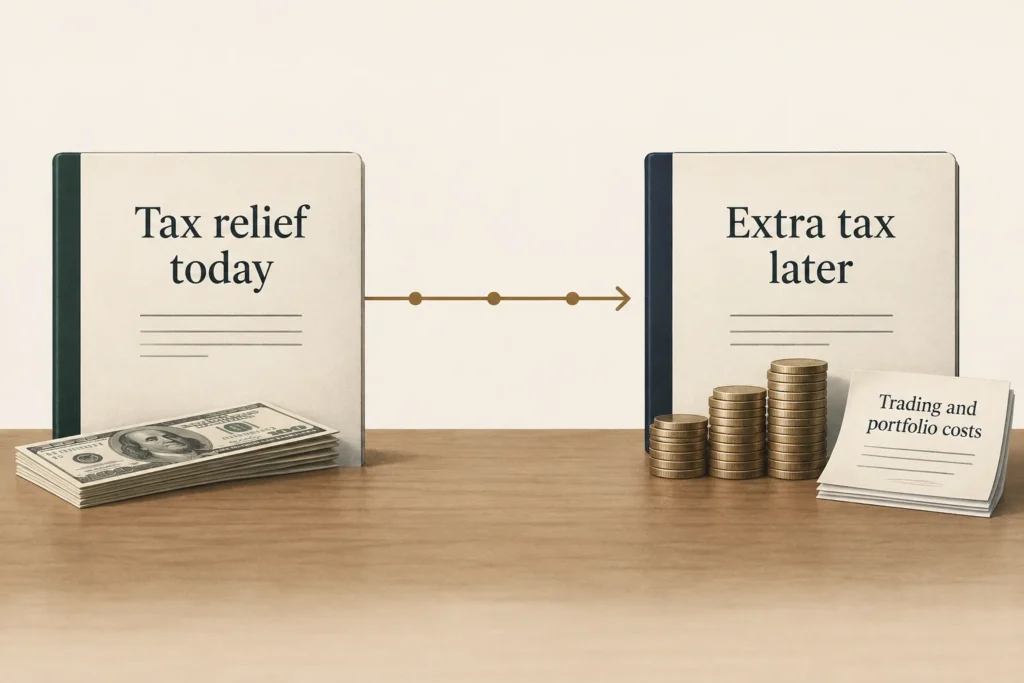
This is a strategy for taxable accounts: sell an investment below its tax basis, recognize the loss, and, if appropriate, buy a replacement that maintains your desired exposure. Selling a losing holding inside an IRA or 401(k) doesn’t generate a deductible capital loss on your individual return.[1][2]
First, what would this particular loss save you?
The familiar $3,000 figure isn’t $3,000 off your tax bill. Capital losses go through the required short-term and long-term gain-and-loss netting process first. If you end with a net capital loss, generally up to $3,000 can offset other income annually, or $1,500 if you’re married filing separately. Unused losses generally carry forward.[2]
In dollars: an additional $3,000 loss offsetting gains otherwise taxed at 15% saves a simplified $450 in federal tax. A fully usable $3,000 deduction against ordinary income taxed at 24% saves $720. You don’t get to pick the better deal. Your return’s netting rules determine where the loss lands.[2]
I’d look at your existing losses before placing another trade.If you already have carryforwards to cover your gains and your annual deduction, the new loss may not benefit you this year. It may benefit you later, but right now you're betting on when you’ll use it and at what tax rate. Low taxable income can also affect how much loss is used, so it’s the Schedule D carryover worksheet, not an automatic $3,000 subtraction, that determines what loss carries over.[2]
The deduction leaves a lower basis behind
Now for the part I don’t want a tax-saving headline to skip. Say you invested $10,000, it fell to $7,000, and you sold it and replaced it with a qualifying replacement for $7,000, avoiding a wash sale. You have a $3,000 realized loss, but the basis of the replacement is $7,000.[1][5]
Assume either holding eventually reaches $12,000 and you liquidate after qualifying for long-term treatment. Holding the original produces a $2,000 gain; harvesting and replacing produces a $5,000 gain. At an assumed 15% federal capital-gains rate, those tax bills are $300 and $750. Harvesting creates $450 of additional future tax.[5][7]
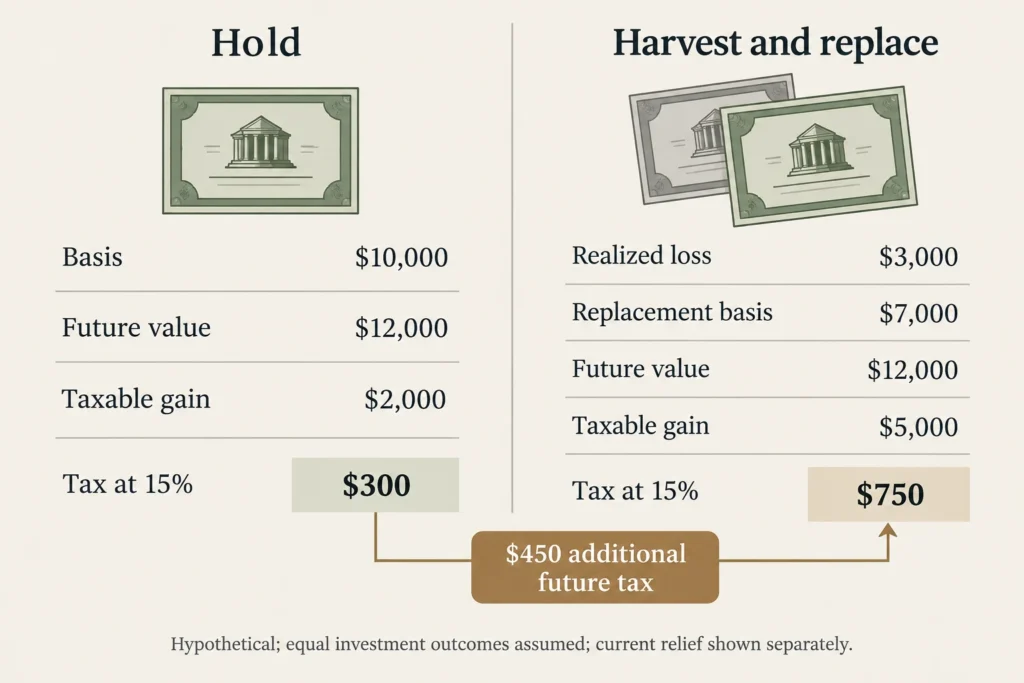
To focus on tax effect, I'm assuming the same ending investment value, no other basis adjustments, and a taxable liquidation. I'm ignoring state income taxes, the net investment income tax, credits, the alternative minimum tax, income-related effects, fees, expenses, and differences in investment performance. The author-created calculations don't reflect measured investment results.
| Assumed current use | Current tax relief | Relief minus future tax, nominal | Present-value benefit over 10 years |
|---|---|---|---|
| Offsets gains taxed at 15% | $450 | $0 | About $146 |
| Fully offsets ordinary income taxed at 24% | $720 | $270 | About $416 |
| Fully offsets gains otherwise taxed at 0% | $0 | , $450 | About, $304 |
I assume you get the relief and pay the $450 tax in 10 years. At a hypothetical 4% annual after-tax discount rate, $450 ÷ 1.04¹⁰ is about $304. Subtract this from the relief for present value. A 4% rate allows comparison of dollars at different points in time. Timing of actual tax payment will be different.[5][7]
The first row shows a tax deferral; a savings in the future (you get the money longer, even if you eventually repay it) and you have an opportunity to reinvest it. The second row also shows a $270 savings due to the difference in the assumed tax rate. The third row is the one I’d be apprehensive about; a loss is completely consumed against a gain which is fully taxable. An unused carry-forward is a loss which may have future value.[2][7]
Comparing current circumstances to future may be less attractive. For example, assuming a future 24% tax rate, that $3,000 basis difference results in a $720 tax difference rather than a $450 tax difference. I would not assume a lower tax rate upon retirement. Vanguard’s modeling and other related studies in the Financial Analysts Journal provide a narrower range of outcomes; both have Vanguard-affiliated authors. Neither provides a dependable annual return for you.[6][7]
The wash-sale check reaches beyond one account
A wash sale happens when you replace a security with substantially identical securities within 30 days (a 61 day window including the sale date) of the sale, and disallows the loss on the replaced security. Purchases made within the 30 day window, automatically reinvested dividends, or purchases made by your spouse can all contribute to a wash sale. A wash sale only disallows the loss on the matched shares, and does not affect loss on other shares.[1]
Imagine I’m about to sell a fund at a loss, pleased that I’ve finally found a useful task for a red number. Then I notice its dividend reinvested last week and another purchase is scheduled in my Roth IRA tomorrow. My enthusiasm cools. I pause the trade, stop the scheduled purchase, and inspect the earlier reinvestment before deciding how much loss the sale could actually preserve.
Turning off future purchases doesn’t undo earlier ones. For a hypothetical November 16, 2026 loss sale, review substantially identical acquisitions from October 17 through December 16. December 17 is outside that sale’s post-sale window, though other transactions can create their own windows.[1]
Don’t consider a clean broker report as proof of a loss. Your broker may not see trades at other brokers or in your spouse’s account. Keep confirmation and basis records in all accounts. You may need to complete Form 8949, code W, to make a wash sale adjustment even if your broker does not show the full disallowed loss.[3]
Keep the investment plan, not necessarily the ticker
I wouldn’t swap the portfolio you want for a deduction. Analyze the replacement’s asset class, geography, company size, sector concentration, index construction, expenses, and liquidity, and compare those to your current holding. A fund that focuses on a small number of industries may not be an equivalent substitute to a broad market fund just because they both contain stocks. Cash may not always be king, but in this case, waiting to trade may protect your principle, and also give you the opportunity to buy back in at a more favorable price in the future.[7]
A fund may fit your portfolio, regardless of the tax implications. Publication 550 mentions “substantially identical” is a facts-and-circumstances case and gives no broad ETF pair safe harbor. Different tickers don’t resolve the issue. If you can’t ascertain how the proposed pair is treated, don’t perform that action, and get a tax assessment for that action and trade only if the intended deduction is needed.[1]
I would harvest when you can identify a valuable use for the added loss, account for the replacement’s lower basis, and anticipate plausible future tax consequences, and still net a gain after all costs, and changes in exposure. Uncertain treatment of the replacement, and the cost of additional administration, is a valid reason to not harvest. If the loss already serves its purpose, and the additional expected gain is small, not harvesting is appropriate. The red number doesn’t necessitate a trade.
Sources and references
- Internal Revenue Service: Publication 550 (2025), Investment Income and Expenses
- Internal Revenue Service: Instructions for Schedule D (Form 1040) (2025)
- Internal Revenue Service: Instructions for Form 8949 (2025)
- Internal Revenue Service: Revenue Ruling 2008-5
- Internal Revenue Service: Topic no. 703, Basis of assets
- Financial Analysts Journal; Kevin Khang, Thomas Paradise, and Joel Dickson: Tax-Loss Harvesting: An Individual Investor’s Perspective (2021-09-22)
- Vanguard: Tax-loss harvesting: Why a personalized approach is important (2024-07)